TheSILVIAs.TheSILVIAs — Silvia Stephenson

MediaViz AI · 0→1 AI Product Strategy

The model worked. That was the easy part.

MediaViz AI could analyze imagery on subjective attributes, composition, mood, aesthetic signal, personal preference. Nobody had built a product around that before, so there was no playbook to copy. My job was finding the customer, the workflow, and the scope worth building.

Role
Head of Product + Design
Years
2020 – 2023
Focus
AI · 0→1 SaaS · Distributed teams
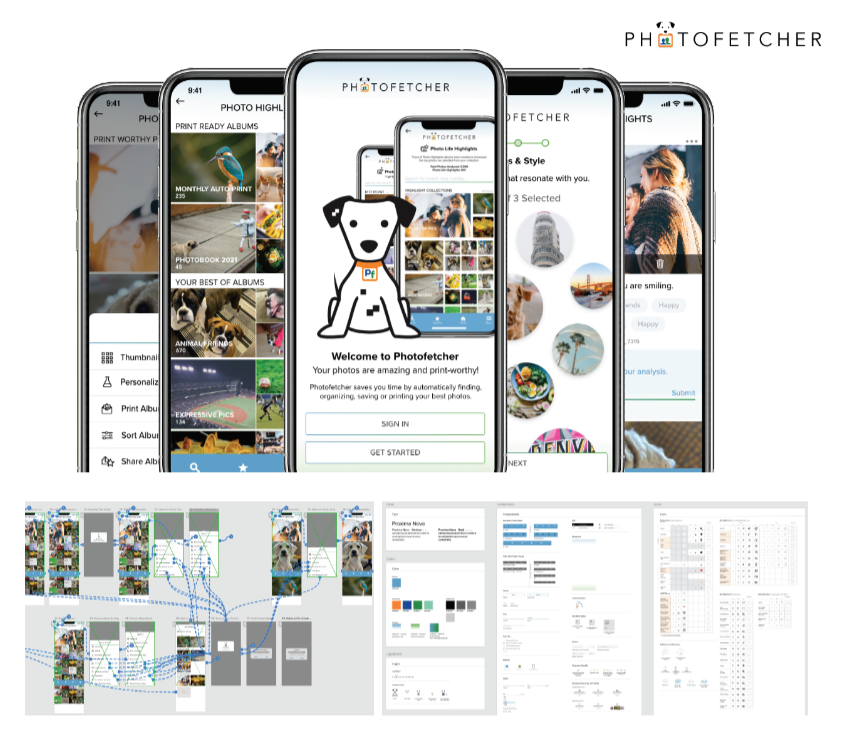
Photofetcher mobile app screens and UX artifacts showing AI-powered photo discovery, album creation, and design system documentation

Context

MediaViz AI was an early-stage company with a genuinely differentiated capability: image analysis on subjective attributes rather than object detection. It could read composition, mood, aesthetic quality, and personal preference signals.

Emerging capability with no established product category is a specific kind of hard. The demo impresses everyone and commits no one. There was no comparable product to benchmark, no obvious buyer, and no workflow the technology naturally slotted into.

I led product strategy and UX, working across a flat startup structure and distributed engineering and design teams in Latin America.
The challenge

User
People have far more images than attention. The unsolved job was deciding which images are worth keeping, printing, publishing, or promoting, a judgment call, not a search query.
Business
Pre-revenue with a technology-first story. Enterprise clients and investors needed to see a product, not a model card.
Organization
Lean technical team, flat structure, and no product or design practice, so scope discipline had to be created alongside the product.
Market
Subjective AI outputs are hard to evaluate. Being 'right' is contextual, which makes trust and framing a product problem.

My mandate

Role
Head of Product + Design, product strategy, UX, and delivery for a 0→1 AI image intelligence SaaS platform.
Authority
Target customer definition, use case validation, MVP scope, roadmap, UX direction, product and design practice.
Team
Distributed engineering and design teams in Latin America. [ADD: team size and disciplines]
Disciplines
Product, UX, data science collaboration, engineering, brand, front-end development.
Stakeholders
Founders, data science, offshore engineering, enterprise prospects, investors.
Timeframe
2020 – 2023

What I learned first

  • Model capability and customer need were not the same list.

    The model could produce many signals. Only a few mapped to a decision someone was already trying to make, which images to surface, print, or promote.

  • Subjective output needs a forgiving interaction model.

    When results are judgments, the product has to invite correction and preference rather than assert a single right answer. Confidence framing changed perceived quality more than model changes did.

  • Edge cases were the product spec.

    Low-quality inputs, ambiguous scenes, and preference conflicts defined most of the real workflow design. [ADD: customer discovery metric, interviews, segments, validated use cases]

  • Enterprise buyers and investors needed to touch it.

    Slides did not carry the idea. An interactive artifact did. [ADD: investor / enterprise outcomes]

With emerging technology, everyone can list what it might do. The job is deciding what it should do first.

Strategy

  • Lead with a bounded, demonstrable use case rather than a general-purpose 'AI for images' platform.
  • Use Photofetcher, an interactive AI image insights product, as the concrete expression of the capability for enterprise clients, investors, and early users, and as the foundation for continued development.
  • Design around human judgment: surface AI suggestions, keep the person in the decision, let preference teach the system.
  • Translate data science constraints into scope: ship the signals that were reliable, defer the ones that were interesting.
  • Establish AI ethics guidelines and governance workflows early, before the product had users to harm.
  • Build the minimum product practice, intake, critique, sprint rituals, requirements, handoffs, so a distributed team could execute without a manager in the room.

Decisions and tradeoffs

Build Photofetcher as a real interactive product rather than a slide-based demo.

Why
Subjective AI has to be experienced. Enterprise clients and investors needed to feed in their own images and see the judgment happen.
Tradeoff
Consumed engineering and design capacity that could have gone to platform infrastructure.
Result
Delivered a React product that demonstrated the platform's capabilities and set a clear product direction; continuous user testing drove iterative improvement and new features. [ADD: investor / enterprise outcomes]

Narrow to a specific job, finding the best images worth keeping and printing, instead of a general image intelligence API.

Why
A general platform had no user to test with and no story to sell. A specific job produced a testable hypothesis.
Tradeoff
Left obvious adjacent markets untouched and made the company look smaller than the technology was.
Result
A concrete workflow to validate and iterate against. [ADD: number of prototypes tested and validation results]

Keep the human in the loop on every AI judgment.

Why
Aesthetic judgment is personal. A system that decides for you is wrong in a way users cannot forgive.
Tradeoff
More interaction design and more steps than pure automation.
Result
Preference and correction became product signal instead of user frustration. [ADD: usability testing outcomes]

Establish AI ethics guidelines and governance workflows before scale.

Why
Subjective judgment about people's images carries real bias and consent risk. Retrofitting governance after launch is how startups end up with an incident.
Tradeoff
Slowed some feature work and constrained a few appealing capabilities.
Result
Responsible development practices and user-centered AI decision-making embedded in how the team worked.

Leading through it

  • Sat between data science and customers, translating what the models could do into what customers actually needed, in both directions.
  • Led cross-functional delivery across distributed engineering and design teams in Latin America, holding alignment on scope and requirements in a flat structure with no formal process.
  • Built product and design practices from the ground up: intake, critique cycles, sprint rituals, requirements documentation, delivery handoffs.
  • Prepared and supported enterprise and investor demonstrations, tuning the product narrative to the audience without changing the product.

What we built

From capability to concept

Customer discovery, market opportunity analysis, and use case validation to define the target customer and identify workflows where subjective image analysis changed a real decision.

[ADD: customer discovery metric, interviews conducted, segments explored]

Photofetcher: the product expression

An interactive AI image insights product that analyzed images on composition, mood, and personal aesthetic value; surfaced highlights and print-worthy selections; and let people teach it their preferences.

I led end-to-end product design and development: creative direction and branding, product design and UX strategy, information architecture, wireframes and interactive prototypes, design system and custom iconography, and cross-functional product management.

Prototype, test, iterate

Continuous user testing informed iterative improvements and new feature development, with findings feeding directly into roadmap decisions.

[ADD: number of prototypes tested and key test findings]

Practice and governance

Product and design operating practices for a lean technical team, plus AI ethics guidelines and governance workflows supporting responsible product development.

Photofetcher product screens, wireflows, and design system artifacts.

Outcomes

Shipped
interactive React product used with enterprise clients and investors
Defined
target customer, high-value workflows, and MVP scope from raw capability
Established
AI ethics guidelines and governance workflows
[ADD]
customer discovery interviews

What changed

  • The company could show a product instead of explaining a model.
  • Product decisions started with a customer decision rather than a model capability.
  • A distributed, process-light team gained enough structure to ship predictably.
  • What I carry forward: with emerging technology, the scarce skill is not imagination, it is choosing which single job to be credible at first.