TheSILVIAs.TheSILVIAs — Silvia Stephenson

Towne.io · Product Strategy + SaaS Platform Leadership

A pivot from marketplace to platform, decided by the customer problem.

Towne started as a consumer marketplace startup. The durable problem was somewhere else: independent retailers drowning in fragmented commerce systems. I led the strategic pivot to a B2B omnichannel retail SaaS platform and defined the product, integration, AI, and monetization strategy behind it.

Role
Head of Product + Design (client engagement)
Years
2023 – Present
Focus
B2B SaaS · Omnichannel retail · AI strategy
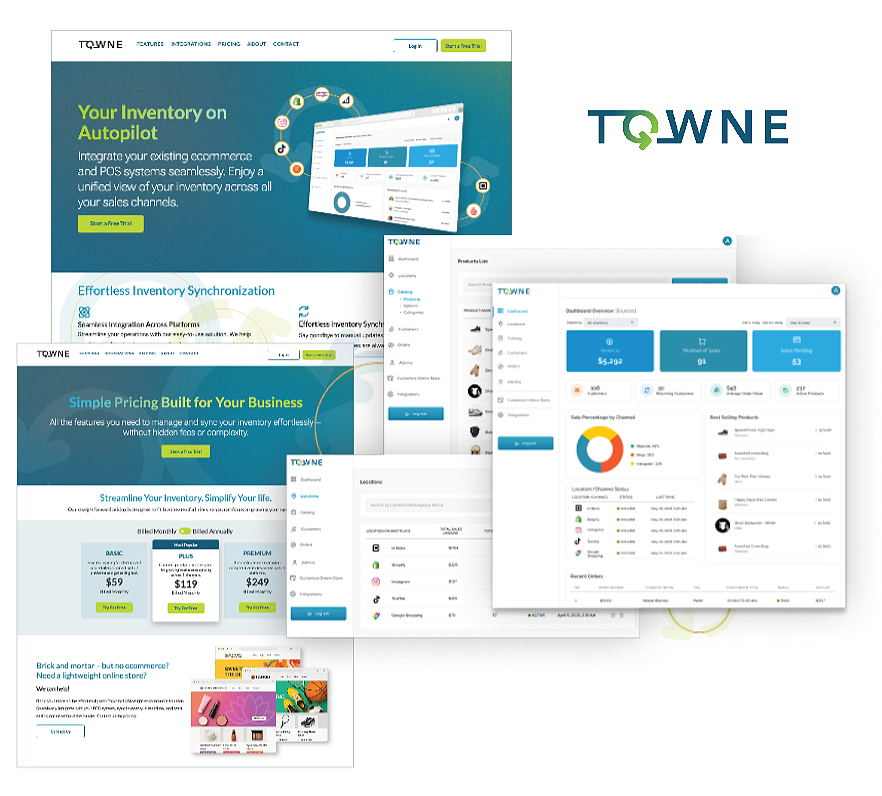
Towne marketing site, pricing page, dashboard, and product screenshots for the omnichannel retail SaaS platform

Context

Towne is an early-stage company with a consumer marketplace premise and limited traction. The founding team had energy, a small budget, and an assumption that the answer was a better shopping experience for local retail.

The retail reality underneath was harsher. Independent retailers were already running a POS, sometimes an online store, sometimes a marketplace channel or two, and paying for that fragmentation in overselling, stale listings, manual counts, and no honest view of what was actually working.

I came in as Head of Product + Design for the engagement, with the mandate to figure out whether there was a business here and, if so, what it was.
The challenge

User
Retailers were reconciling inventory by hand across channels, discovering oversells after the fact, and making buying decisions on incomplete data.
Business
A consumer marketplace demanded two-sided acquisition spend the company could not fund. B2B SaaS offered a payable problem and recurring revenue.
Organization
A small, lean team with no product operating system, which meant strategy had to arrive with scope discipline attached.
Market
Enterprise-grade omnichannel tools exist and are priced and configured for people who are not independent retailers.

My mandate

Role
Head of Product + Design for a 0→1 omnichannel retail SaaS platform.
Authority
Product vision, MVP scope, roadmap, requirements, UX direction, AI strategy, packaging and pricing recommendations.
Disciplines
Product strategy, customer discovery, UX, integrations, GTM, positioning, monetization.
Stakeholders
Founders, engineering, prospective retail customers, investors.
Timeframe
2023 – Present

What I learned first

  • The pain was operational, not experiential.

    Retailers were not asking for a nicer storefront. They were asking to stop selling the same item twice and to stop spending evenings on reconciliation.

  • Trust in sync is the entire product.

    If a retailer cannot tell whether a sync ran, what it changed, and what to do when it fails, they revert to spreadsheets. Sync status, alerts, and history were core, not settings.

  • Channel mix varies wildly, so integrations are a segmentation strategy.

    Which platforms a retailer already runs, Square, Shopify, Lightspeed, WooCommerce, BigCommerce, TikTok, Instagram, Google Shopping, determines both the value and the onboarding cost.

  • AI has to be accountable to survive contact with a merchant.

    Retailers were open to automation and unwilling to let software change prices or listings unsupervised. That constraint shaped the whole agentic roadmap.

Retailers didn't want a better storefront. They wanted to stop selling the same sweater twice.

Strategy

  • Redefine the customer: independent retailers running multi-channel operations, not consumers browsing local goods.
  • Anchor the platform on one core job, unify inventory and sales across POS, eCommerce, and marketplace channels, and refuse scope that does not serve it.
  • Build integration breadth as the wedge: Square, Shopify, Lightspeed, WooCommerce, BigCommerce, TikTok, Instagram, Google Shopping.
  • Layer intelligence on top of reliable sync: reporting, sales insights, channel performance, sync scheduling, alerts, customer intelligence, and lightweight eCommerce.
  • Phase AI from assistive to agentic, inventory intelligence, campaign creation, listing optimization, forecasting, recommendations, with human-approved actions, permissions, audit history, and rollback.
  • Package AI as the path to higher-value tiers, expansion revenue, and retention rather than a checkbox feature.

Decisions and tradeoffs

Pivot from consumer marketplace to B2B omnichannel retail SaaS.

Why
The marketplace required funding two-sided acquisition against incumbents. The retailer's operational problem was already costing them money and time every week.
Tradeoff
Abandoned existing consumer-facing work and narrative; slower initial story, harder technical build, but a payable problem.
Result
Redefined customer problem, product vision, MVP, roadmap, requirements, workflows, and UX around independent retailers. [ADD: pipeline or revenue signal post-pivot]

Make inventory synchronization the MVP core and defer richer eCommerce capability.

Why
Sync is the trust-building function. Everything else, insights, campaigns, AI, is only credible once a merchant believes their counts are right.
Tradeoff
Launched with a thinner storefront story than competitors that lead with selling tools.
Result
MVP scoped to something a lean team could ship and a retailer could evaluate in a free trial. [ADD: activation and trial-to-paid rate]

Require human approval for agentic AI actions, with permissions, audit history, and rollback.

Why
Retailers will not hand pricing and listings to an autonomous system, and an unrecoverable bad action would end the relationship.
Tradeoff
Less dramatic automation story and more product surface to build than a fully autonomous pitch.
Result
An AI roadmap merchants can adopt incrementally, and a defensible investor narrative. [ADD: AI feature adoption]

Design pricing and packaging as part of the product strategy, not after it.

Why
Tiering decides which capabilities must exist at launch. AI packaging in particular determines whether intelligence is a cost center or the expansion engine.
Tradeoff
Constrained the roadmap to what each tier could justify, cutting features that had no place to live commercially.
Result
Tiered model supporting higher-value plans, expansion revenue, and retention. [ADD: ARPU / tier mix]

Leading through it

  • Worked directly with founders to retire the original premise without retiring the team's confidence, the pivot was framed on evidence, not opinion.
  • Translated strategy into execution-ready requirements, workflows, and prototypes so a small engineering team never had to guess at intent.
  • Aligned GTM, positioning, and product scope so the marketing site, pricing, and MVP told the same story.
  • Built lightweight product operating practices for a lean team: intake, prioritization, delivery rhythm, and decision records.

What we built

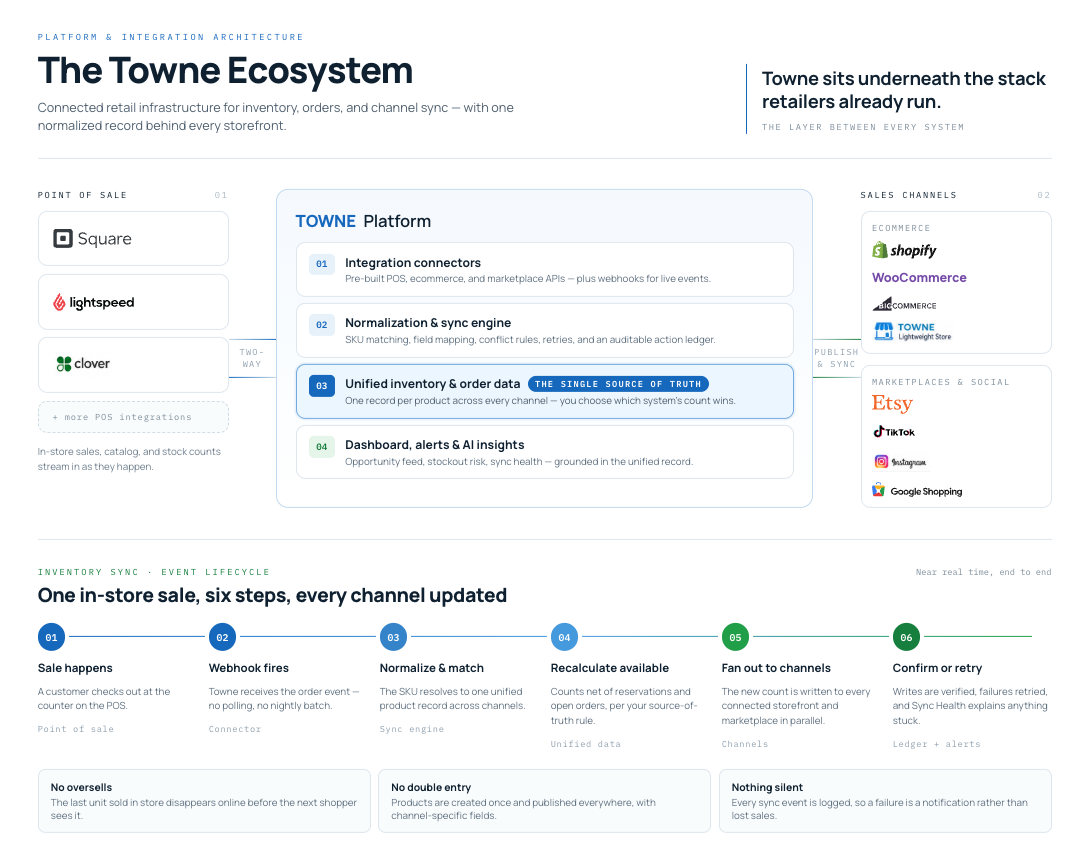
Platform and integration architecture

Product architecture for connecting POS, eCommerce, and marketplace channels into one inventory and sales source of truth, with sync scheduling, conflict handling, alerts, and status transparency.

The Towne ecosystem diagram showing POS and eCommerce integrations feeding into a unified platform, plus the inventory sync workflow across six steps

Dashboard and core workflows

Connections, sync status, alerts, reporting, sales insights, channel performance, and customer intelligence, organized so the first screen answers 'is my inventory right?' before anything else.

Brand, marketing site, and pricing

Rebrand and naming strategy, responsive marketing site with SEO foundations, pricing and packaging presentation, and a design system built for consistent scaling.

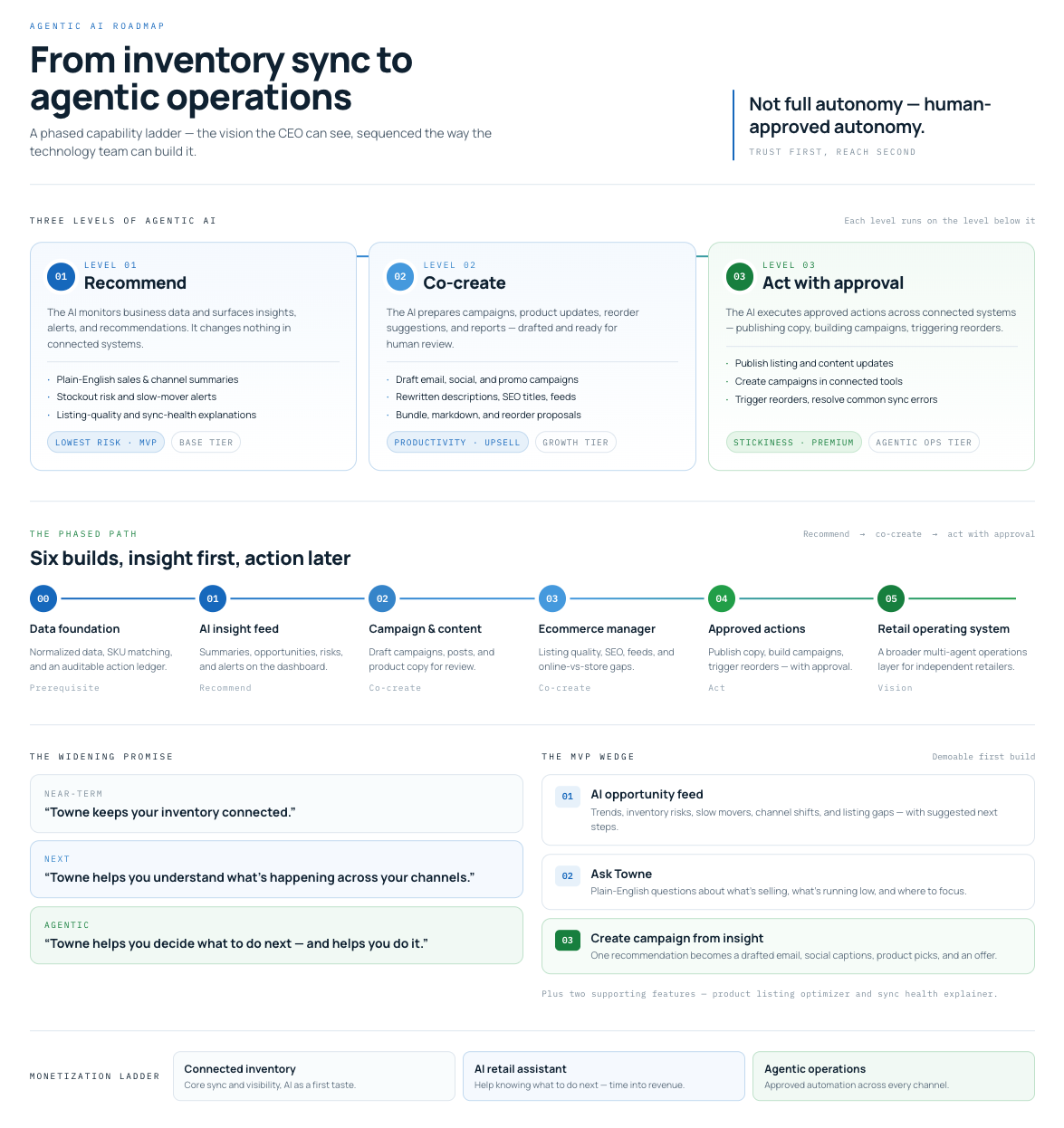
AI and agentic roadmap

A phased plan moving from inventory intelligence and forecasting to campaign creation, listing optimization, and human-approved agentic actions, with permissions, audit history, and rollback designed in from phase one.

Agentic AI roadmap showing three levels of AI capability and a phased path from inventory sync to agentic operations.

Outcomes

Launched
brand, marketing site, and MVP experience with free trial
8
commerce and marketplace platforms in the integration strategy
Phased
AI roadmap with monetization and investor positioning
[ADD]
retailers onboarded
[ADD]
trial-to-paid conversion
[ADD]
revenue / ARR signal

What changed

  • Towne stopped competing for consumer attention and started solving a problem retailers already budget for.
  • The company gained a roadmap it could fund, staff, and sell against.
  • AI became a monetization strategy with governance attached rather than a feature list.
  • What I carry forward: pivots are cheaper than they feel when the evidence is specific and the new scope is smaller.