TheSILVIAs.TheSILVIAs — Silvia Stephenson

PropertyBot.io · Product Judgment

Good product leadership includes knowing when not to build.

PropertyBot was an AI-enabled real estate automation platform for property research, data aggregation, and workflow management. I co-founded it, led 0→1 product, validated it properly, and then made the call to stop.

Role
Product Leader + Co-founder
Years
2023 – 2024
Focus
0→1 · Validation · Real estate automation
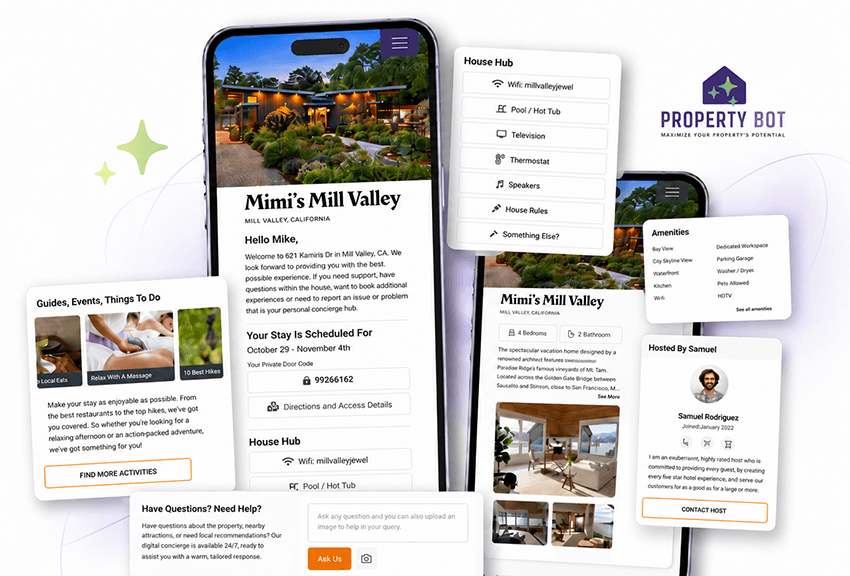
PropertyBot guest experience screens showing property welcome page, house hub, amenities, and concierge chat

Context

PropertyBot.io was an AI-enabled real estate automation platform designed to streamline property research, data aggregation, and workflow management for homeowners and real estate professionals.

The starting observation was real: property research is fragmented across public records, listing data, tax and permit information, and a dozen tools that do not connect. People genuinely waste hours on it.

I co-founded the company and led 0→1 product strategy. The interesting part of this case study is not the product. It is how the decision to stop got made.
The challenge

User
Homeowners and real estate professionals piece together property information manually across disconnected sources.
Business
A viable business needed a segment with both frequent pain and willingness to pay, those turned out to be different groups.
Organization
Two-person founding effort with finite runway and no appetite for building on hope.
Market
Data access costs, incumbent tooling bundled into brokerage and MLS relationships, and a fragmented buyer.

My mandate

Role
Co-founder and product leader, strategy, discovery, prototype, and go/no-go.
Authority
Full product and investment decision authority alongside my co-founder.
Team
[ADD: team size and disciplines]
Disciplines
Product strategy, customer discovery, UX, prototyping, competitive and market analysis.
Stakeholders
Co-founder, interview participants, [ADD: advisors or prospective investors]
Timeframe
2023 – 2024

What I learned first

  • The pain was real and the frequency was not.

    Homeowners felt the problem sharply and encountered it rarely. Rare pain does not sustain subscription software. [ADD: supporting interview breakdown]

  • Professionals had the frequency and already had tools.

    Agents and investors researched constantly, but their workflows were bundled into existing platform and brokerage relationships that were hard to displace.

  • Aggregation was the cost center, not the moat.

    Most of the value depended on data we would license rather than own, which compressed margin and weakened defensibility. [ADD: unit economics detail]

  • Interest in a demo is not demand.

    Prototype reactions were positive. Willingness to change tools and pay was not. That gap is the whole finding.

Everybody agreed it was a problem. Nobody was going to change what they were doing to fix it.

Strategy

  • Test the riskiest assumption first: that a definable segment would pay to replace their current research process.
  • Buy the answer cheaply, 20+ interviews and competitive research before meaningful engineering investment.
  • Build a prototype real enough to provoke honest reactions, not a production system.
  • Set the kill criteria before running the test, so the decision would not be made emotionally at the end.

Decisions and tradeoffs

Run 20+ user interviews and competitive research before building.

Why
The cheapest version of being wrong is a conversation. The most expensive is an engineering team.
Tradeoff
Slower start and no code to show for the first stretch of work.
Result
Validated pain points, defined target users, shaped MVP scope, and surfaced the frequency and displacement problems early.

Build an interactive prototype instead of an MVP.

Why
We needed reactions to a tangible experience, not a functioning platform. The question was demand, not feasibility.
Tradeoff
The prototype could not prove retention or real usage, only interest and comprehension.
Result
Research translated into core workflows and requirements, and a concrete artifact for user feedback and validation.

Sunset the product.

Why
Validation findings showed the market opportunity did not justify continued investment. The reachable segment with real frequency was already served, and the segment with acute pain would not sustain recurring revenue.
Tradeoff
Gave up the option value of persisting, and walked away from work we liked. The alternative was spending the next year proving the same thing more expensively.
Result
Investment stopped early. Capital and time redirected. [ADD: what the co-founding team did next]

Leading through it

  • Agreed on kill criteria with my co-founder up front, which made the eventual decision a shared conclusion rather than an argument.
  • Kept research honest: asked about current behavior and spend rather than pitching and collecting enthusiasm.
  • Communicated the sunset decision plainly to everyone involved, with the evidence attached.

What we built

Research program

20+ user interviews with homeowners and real estate professionals, plus competitive research, to validate pain points, define target users, shape the MVP, and test product-market fit assumptions.

[ADD: interview breakdown by segment and key verbatims]

Interactive prototype

Research translated into core workflows, product requirements, and a tangible interactive prototype used for user feedback and validation.

[ADD: supporting image or artifact, prototype screens, workflow map]

Decision framework

Assumptions tracked explicitly as validated, invalidated, or unresolved, then weighed against runway, data licensing costs, and displacement difficulty.

[ADD: decision framework artifact]

[ADD: supporting visuals, prototype screens, research synthesis, decision framework]

Outcomes

20+
customer interviews completed
Prototype
designed, built, and tested with target users
No-go
decision reached on evidence before major engineering spend
[ADD]
capital / months preserved by stopping early

This case study exists because the outcome was correct, not because it was positive. Most portfolios only show the things that shipped.

What changed

  • The decision to stop was made in months rather than years, at a cost measured in research time rather than burn.
  • Set kill criteria before testing; it converts a painful judgment call into a pre-agreed reading of evidence.
  • What I carry forward: separate 'this is a real problem' from 'this is a real business' early and explicitly. They are different findings.